Saturday, April 6, 2013

No, David! - Inference

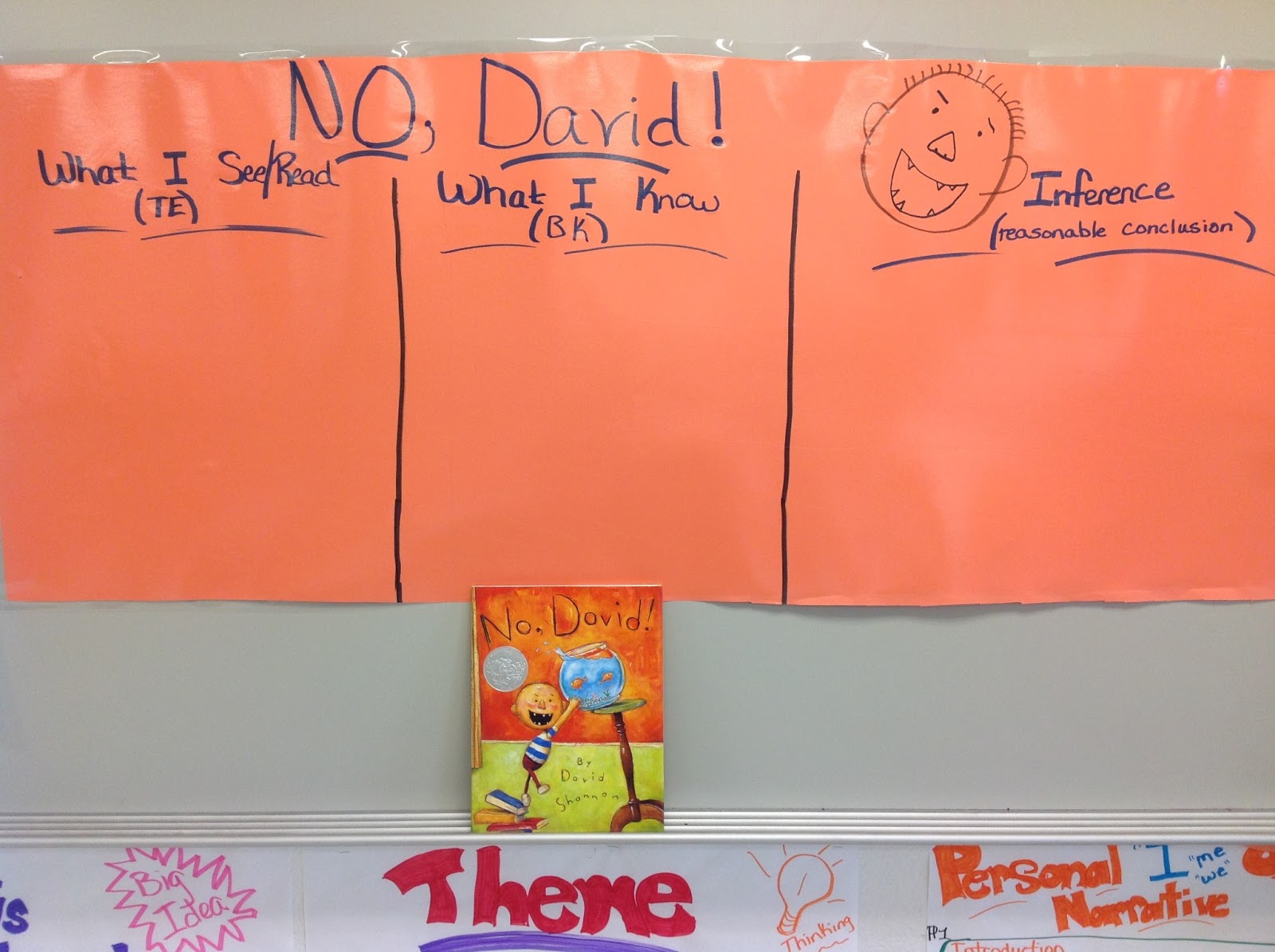
Reviewing Inference:  Day 2 (review pic of Day 1)

Cassie and I used the children's book No, David! by David Shannon to begin our STAAR Reading review.  We started with this for multiple reasons:  kids just took STAAR Writing this week (tired), Inferencing is a HUGE part of the STAAR Reading test, inferencing with a children's book and pictures is a nice ease into the skill.


As I mentioned in my last post, Cassie found this lesson on a kinder teacher's website:
First Grade Parade

This kids LOVED it!

First, we reviewed the Inference Anchor Chart we created the day before.


Then, we did an interactive read aloud of the book.  I read while the pages of the book were projected so the kids could see the pictures well.  You could take your own pictures or do a search on youtube.  There are a few options.

I had a chart posted on the board that mirrored the Inference formula (connection to math) we discussed the day before:

TE  +  BK  =  Logical Inference


I put this chart together based on a  couple of different anchor charts I found on Pinterest.

We then went back through each page and charted the text using text evidence and background knowledge to reach a logical inference.  Each student had their own copy of the No, David inference chart to fill out as we discussed and reviewed.  They were allowed to discuss with their group and then we took turns as groups came up to the board to chart their inference on our class chart.  

What I found what that kids have a hard time understanding what background knowledge really is!  Wow!  So on Monday, we will be reviewing making connections:  T-T, T-S, T-W and the 4 specific types of Inferences.  That way we will be able to further clear up what using background knowledge really means before we move on.  I learned I sometimes take for granted what they should already know.

Success!

Maas Out!

Wednesday, April 3, 2013

Inferencing! The big buzz word, skill, focus,... new ideas

Inferencing...  a HUGE part of our ELA curriculum.  So... jumping into our two week review before STAAR Reading, my teaching partner and I have come up with a few good ideas...actually...stolen ideas from great resources!  Taking a page from Harry Wong's book... STEAL, STEAL, STEAL!  

So, I went to Pinterest and found some great Inferencing Anchor Charts and squished a few together to come up with the following:


Will work on reviewing what it means in general one day, and students will begin their Making Connections folder with this anchor chart on the front:


Stole the Making Connections Unit idea from our 6th grade ELA team (thanks Sara!) and the folder idea from our 7th grade history teacher (thanks Sharon!)!  : )

More will be added to the interior of the folder as we move through the next two weeks: examples, foldables glued in, venn diagrams, charting of text, etc.  More pics to come as I finish my teacher model.

Day 2 we will use the book No, David by David Shannon to do an introduction review to inferencing with pictures as we chart the following for each page as a class:
 1.  What I see/read (Text Evidence)  +  2. What I Know (BK)  =  Logical Inference

My teaching partner, Cassie, got the book idea from a kinder teacher website!
http://thefirstgradeparade.blogspot.com/2012/01/inferencing-with-no-david-and-silent-e.html

The chart idea I got from Pinterest and just tweaked it a bit.

That's it for now!  More to come and will certainly share....  already have another idea for next week that I'm stealing from another 6th grade teacher, Chad, at our sister middle school!  Thanks Chad! Sharing IS Caring!  : )

Maas Out!

Wednesday, March 13, 2013

Stations in Secondary a Must! - Revising and Editing Review

For at least a year, I have wanted to implement elementary stations / centers into my 7th grade classroom.  My sister teaches 2nd grade, and I saw the value of all that she did.  I just couldn't seem to put it together or wrap my head around how I could make it work with 5 classes (137 students) with so many varying levels and styles of learning.

I finally decided to take the leap for a portion of my STAAR Writing Review unit.  I hate test review. I truly do despise it.  The kids are bored, I'm bored and it never ends well.  This year, my principal challenged the teachers to stay creative through our STAAR review.  The dreaded testing review.  My teaching partner and I decided we would stop talking about stations and centers and actually give it a shot.  The kids have already learned the content, so we couldn't really do much damage... : )

We created 8 different stations to work on writing, revising, and editing in different ways. 
1.  Freewrite Station - various prompts and a writer's journal

2.  Revise Your Own Work Station - writer's journal and some score 4 examples

3.  Sentence Organization - hands on manipulatives to create a paragraph
4.  Revising Multiple Choice - Kamico as the source and Edmodo for delivery meithod
5.  Editing Multiple Choice - Kamico as the source and Edmodo for delivery meithod
6.  Sentence Editing - Similar to DOL... not MC
7.  Dead Words Station - Said is Dead and other boring words...provided some replacement word lists
8.  Revising Mulitple Choice Onlinne Game - already made online...just provided a QR code to students to scan

Any of these would work in a 1:1, BYOD, or use of a computer lab for the day environment.

10-15 minutes per station.  Provided a Passport Document to each student to provide evidence from each station.  (image attached)  Students work in groups of 3-4. Travel when music is played.  May work through stations in any order.

After the first day today... I am confident in saying it was a WILD SUCCESS!  It was a completely student led classroom today and 99% were completely engaged.  I even told my principal is was my best day teaching.

The stations weren't as pretty or fancy as my elementary teaching sister would have created, but still pretty darn good for a non-creative secondary type!

At the end of the day, I wished I had done this all year at various points.  Now that my feet are wet, I know it can be done in a secondary classroom with great success.  I challenge you to give it a try!

Maas Out!

Sunday, February 24, 2013

First PBL has come to an end...Tips & Reflections

Well... I can't believe it, but our first PBL has come to an end.  On Friday, students presented a summary of their information from their Action Plan.  Below are my thoughts and tips now that I have lived through my first PBL experience from design to presentation.

First, while not all end products (Action Plan and Presentation) were the quality I would have liked, I am extremely proud of my students for sticking with it and having the courage to stand in front of their peers, parents, and school staff to present their findings.  We only had about 10 minutes the day before to review presentations skills.  And while Thursday was supposed to be a day of practice, it was really a day of groups trying to finish at the last minute because they realized I wasn't kidding about presenting, and YES I DID invite parents, principals, and staff to participate in the audience.  I  must say, I'm really not surprised about the scrambling at the last moment, but I think it will pay off in future PBLs because they now know I'm serious.

One of the first things my partner and I realized we needed to change was the timeline.  Even though the Think Forward Institute told us to keep the PBL to 4 weeks max, we pushed it to 5 because we were reading a novel to complement the PBL.  Well... Think Forward was right.  We COULD have completed the work in 4 weeks, especially Pre-Ap classes.

Another change we would make is using more Centers/Stations for Workshops.  I think we expected a little too much from the get go, and it back fired a little bit with 7th graders.  I think groups traveling from center to center in a class period or two would be better than the single workshop style we used during this PBL.  At the 7th grade level, it is important for all members of the group to get all the information rather then sending one person per group to the workshop and rely upon that sole person to re-explain the information to the rest of the group.

On the same topic of Workshops, we realized we should have used the resources around us more for workshops:  librarian, counselors, and technology staff.  All of those groups could have helped us by coming in to conduct a workshop with students rather than them all coming from the teacher or materials.

Edmodo was an invaluable tool during the entire PBL.  It stored all documents and resources including Entry Event Document, Rubrics, Research Material, Quizzes, etc.  It was an important organizational tool for our 1:1 iPad school for this PBL.  In addition to using Edmodo, each group also had a folder that contained PBL resources.  That was  GREAT idea because there was NO excuse for not having access to the appropriate documents or information at any point in the PBL.

One thing I did find was that students had a difficult time taking the information they had researched and idea they had written down on their Action Plan and turning it into a presentation.  They left out quality information from their written words.  This lesson in disconnect helps me understand they need more scaffolding at that point in the project.  They also had a hard time taking the feedback from Critical Friends and revising their work.

Overall, I feel our first PBL was a success.  I'm so happy we implemented almost immediately after training.  I think it made a big difference and has allowed us to reflect on what we can change, add, delete, etc for our next attempt.

Now... I'm off to stick my head in the sand for a few hours... Oh wait... I have to grade final Action Plans, start a new unit, and plan the next Research PBL...  Who am I kidding... I'm a teacher.  No rest for the weary.... Off to work I go... THANK GOD I LOVE IT!

Maas Out!

Tuesday, February 19, 2013

Critical Friends - Wow!

Last Thursday and Friday, we (my teaching partner and I) invited staff members from our campus and district office to participate in our PBL Critical Friends.

For those of you unfamiliar with Critical Friends, this is the point in the process where PBL groups received critical feedback regarding their end product prior to final presentations.

We had teachers, facilitators, interns, and even technology staff come over and spend time with groups to provide them with three pieces of feedback:  What I Like, Things I Wonder About, and Next Steps.  My teaching partner and I even swapped classes for a day to provide feedback to each other's classes!

We simply created a Google Doc with class periods, emailed the link, and asked staff members to sign up for a class period or two if they had time.  We had a great response!

Groups then took the feedback and are using it as a basis for revisions.

Originally, Think Forward taught us that peer groups should provide the critical feedback.  Since we launched PBL in the middle of a year and at the 7th grade level, we decided to use adults.  They were so gracious and helpful to our students, and our students realized just how important it was too have work completed when they found out they had to present their drafts to adults who were strangers for the most part.

Overall things went really well.  However, we are in the process of revising and editing, so I am hoping that the groups will use all of the feedback to truly make their end products better.  I am working my way through groups for two days as they revise and edit to verify as best I can.

Presentations are Friday!  I will post more after I see final products.  Wish us luck!

Maas Out!

Tuesday, February 12, 2013

Success & Resources

Resources that have provided success!

Today, I want to express thanks to all the people, websites, and sources that have provided the resources my teaching partner and I have needed to increase the success of our PBL.  I have to say that I really do consider our novel PBL a success even though it isn't quite over yet.


  • Edmodo.com - We have used this site to house PBL documents, quiz students over reading, provide research resources, provide workshop resources, provide small group communication spaces, and much more.  Best of all... it's FREE!  Students can access it online anywhere through the website or app.
  • BIE.com - This website have provided information, links, ideas, etc.  We also have the book which our district has available to all teachers and was given to use when we attended the Think Forward Institute @ManorISD.
  • Twitter - I follow many techies, teachers, and districts that talk about PBL in order to get ideas.  Try following @ManorISDIT for great resources.  They tweet often!
  • My Peeps : )  - Of course there are many to thank here!  My teaching partner, Cassie Reynolds... ELA Instructional Facilitator, Shay Garland who spent countless hours helping us prepare for this PBL... My principal, Tammy Becker, and Campus Facilitator, Ava Bartek, and other district staff for making sure we have all the materials we need for our PBL...Think Forward Staff @ Manor ISD...and our other ELA teachers who have all shared their thoughts and experiences as we implement PBL together at SBMS!
LOVING IT!
Follow me on Twitter:  @MaasClassroom

 
Maas Out

Monday, February 4, 2013

Surprising! PBL Success!

We are in Week 5 of our first PBL, and it has been filled with wonderful surprises!


  • Students are engaged.
  • Students are truly thinking.
  • Students are choosing to read materials and make connections.
  • Learning is actually authentic.
I have really been pleasantly  pleased with the amount of control my students have taken on to be successful in their groups for our PBL.

Of course, I have some who just simply won't work or turn in poor quality work, but the reality is students are working harder and learning more than they could have in a traditional classroom.  

My only wish... I had started with PBL in September.

Pleasantly Pleased,
Maas